

Choosing silicone oil is most effective when its type, grade, and viscosity match the intended application and operating conditions. Silicone oil is a synthetic oil based on silicone compounds. Due to its good resistance to heat, moisture, and oxidation, it is widely used in various industrial applications.
Silicone oil is used in industries such as automotive, electrical and electronics, plastics manufacturing, and mechanical equipment. Its final selection depends on factors such as operating temperature, viscosity, material of the component, and environmental conditions.
Properties of Silicone Oil
Industrial silicone oil has properties that make it a practical choice for various industries due to its chemical structure. Thermal stability, oxidation resistance, and a wide range of available viscosities are among its key characteristics. Below, we examine the most important properties to consider when selecting silicone oil.
Thermal Stability
Silicone oil has high stability against temperature changes and can better retain its properties under conditions where the operating temperature changes continuously. This characteristic makes it a suitable option for lubricating components exposed to high temperatures or thermal fluctuations.
Resistance to Water and Moisture
Silicone oil offers excellent resistance to water and moisture and is not easily washed away from surfaces. Therefore, by maintaining lubrication and forming a protective layer, it is a suitable choice for equipment that is continuously exposed to moisture.
Electrical Insulation
Silicone oil has low electrical conductivity, which makes it suitable for use in certain electrical and electronic equipment and components.
Chemical Stability
Due to its low chemical reactivity, silicone oil can perform effectively in environments such as chemical industries, manufacturing workshops, laboratories, and processes where contact with chemicals is possible.
Anti-Stick Properties

Silicone oil forms a thin layer on surfaces, preventing materials from sticking and making it easier to remove components. For this reason, it is used as a release agent in plastic molding processes, component manufacturing, and certain industrial operations.
Types of Silicone Oil
When selecting silicone oil, it is important to know that this lubricant is available in different grades and viscosities, each designed for specific operating conditions. Differences in viscosity and physical properties are among the main reasons why silicone oil is produced in a wide range of grades. Silicone oil for cars is also selected according to the type of component and operating conditions, and no single grade can be considered suitable for all applications.
The main types of silicone oil include:
- Low-viscosity silicone oil
- Medium-viscosity silicone oil
- High-viscosity silicone oil
- High-temperature silicone oil
- Industrial silicone oil
Applications of Silicone Oil in Various Industries
Due to its stability and high resistance to environmental conditions, silicone oil is used in a wide range of industries. One of its common applications is in the automotive industry, where certain grades are used for the maintenance and lubrication of specific components. Keep in mind that silicone oil for cars should be selected according to the type of component and its operating conditions.
This oil also has many other applications. Five of the most common include:
- Electrical and electronics industries
- Plastic and rubber industries
- Mechanical equipment
- Textile industries
- Molding processes
Important Tips for Choosing Silicone Oil
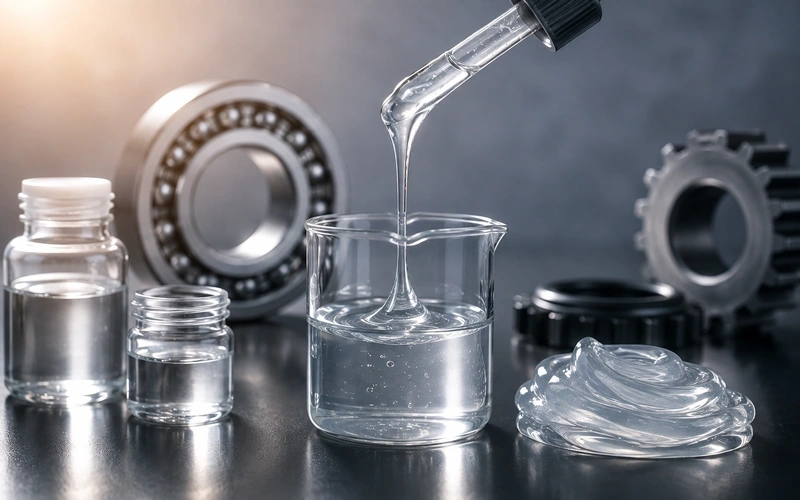
The selection of industrial and non-industrial silicone oil should be based on the intended application and the conditions in which the oil will be used. Key differences in viscosity, temperature range, and performance characteristics mean that each grade is suitable for specific applications. Therefore, when choosing silicone oil, do not focus only on the product name; make sure its technical specifications match your requirements. The most important factors to consider are as follows:
- Viscosity: For general applications, grades ranging from 100 to 1000 are commonly used.
- Operating temperature: The oil should be selected according to the operating temperature. Standard silicone oils are generally used within a temperature range of -50°C to +200°C.
- Oil purity: For more sensitive applications, particularly precision equipment and electronics, it is better to use high-purity oil with lower levels of impurities.
- Thermal stability: If the operating temperature is high, choose a grade whose permissible temperature range exceeds the actual operating temperature of the equipment.
- Water resistance: In humid environments, choose an oil with very low water absorption that remains stable when exposed to moisture.
In this article, we learned what silicone oil is and why its thermal stability and resistance to moisture and oxidation make it useful in various industries. The appropriate grade should be selected based on the intended application and equipment specifications. In the automotive industry, silicone oil for cars is only a suitable choice when it is compatible with the vehicle's components and operating conditions.