

Choosing the best grease for bearings is not limited to the type of grease, as each bearing operates under specific conditions in terms of speed, load, temperature, and working environment. Rotational speed, ambient temperature, and equipment type are among the most important factors that determine which grease can provide suitable performance. Therefore, when selecting a lubricant, it is recommended not to make a decision based solely on the general name of the grease and to consider the bearing’s technical specifications.
Below, we examine commonly used greases for bearings and review their selection criteria.
List of the Best Greases for Bearings
The choice of bearing grease depends on its operating conditions, and no single type can be considered the best lubricant for all equipment. The thickener type, NLGI grade, base oil viscosity, and load level are among the most important specifications to consider when making the final selection. Based on these factors, the following are common options for bearing grease:
- Lithium grease: The best grease for wheel bearings and suitable for general applications and normal operating conditions
- Lithium complex grease: Suitable for high temperatures and very heavy loads
- Polyurea grease: A suitable option for electric motor bearings
- Calcium sulfonate complex grease: Suitable for humid environments and applications involving water exposure
- EP grease: Suitable for bearings subjected to higher loads and pressures
- Synthetic grease: Suitable for specific temperature and speed conditions
- Molybdenum disulfide grease: Suitable for heavy loads and low-speed applications
Features of the Best Grease for Bearings
The best grease for wheel bearings is a grease that, in addition to providing lubrication, can protect the internal surfaces of the component under actual operating conditions. Selecting grease based on the following properties can help reduce the risk of increased temperature, wear, and reduced bearing performance.
- High-temperature resistance:
The grease should be able to form and maintain a lubricating film when entering the bearing. This property is particularly important for bearings operating under heavy loads. - Resistance to water and moisture:
Suitable grease should not be washed away quickly or change its consistency when exposed to water. This property is especially critical if the bearing operates in a humid environment. - Oxidation stability:
The grease should have sufficient resistance to oxidation so that it does not lose its quality during long-term operation and increased temperatures. - Proper adhesion:
The best bearing grease should have an appropriate level of adhesion so that it remains at the bearing lubrication point and does not quickly leave the area due to rotation or centrifugal force. However, excessive adhesion may not be suitable for some high-speed bearings.
Tips for Choosing the Most Suitable Grease for Bearings
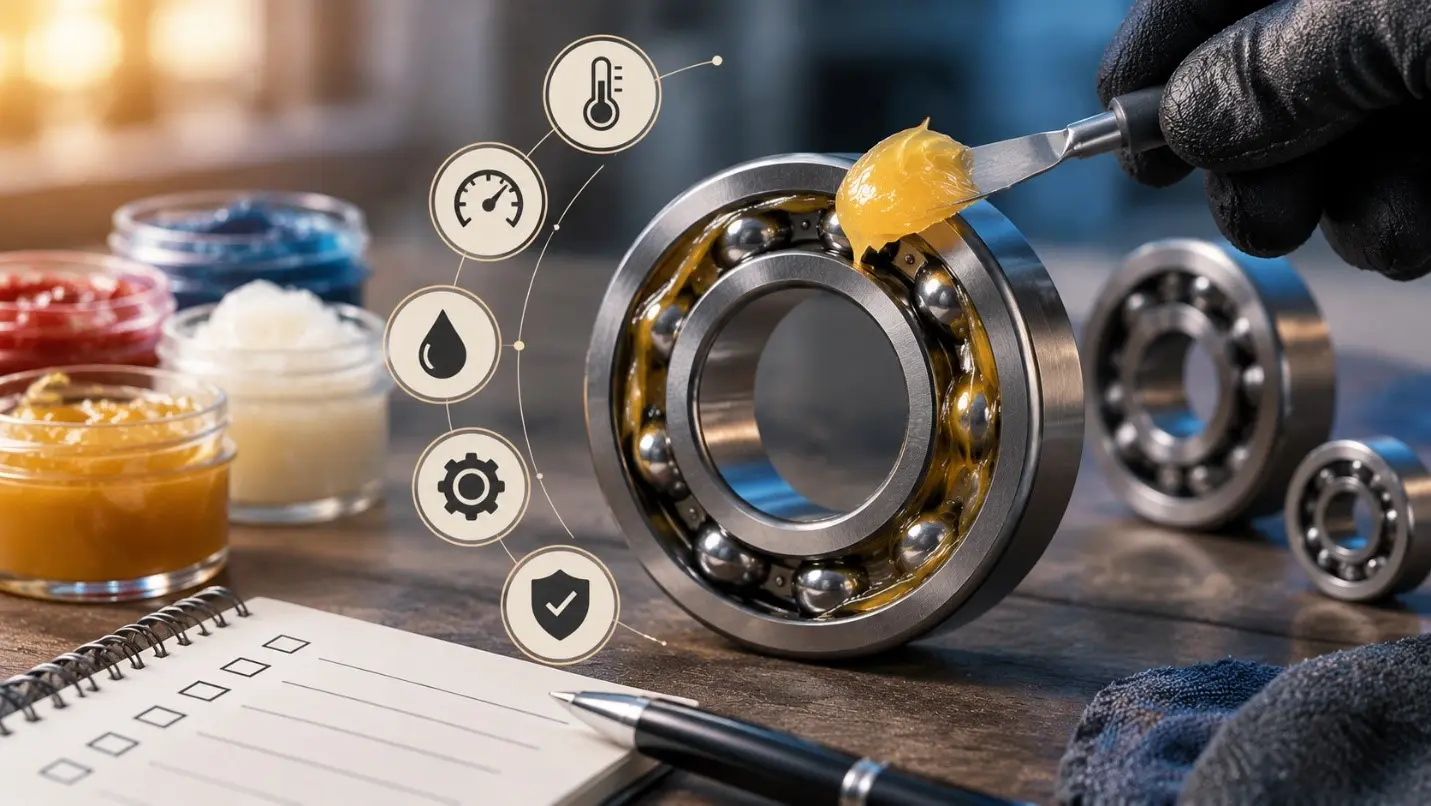
Choosing the best bearing grease provides the desired results when the lubricant is compatible with the actual operating conditions of the bearing. Factors such as speed, temperature, moisture, and even the grease structure can affect its performance. Therefore, several important specifications should be considered together before making a selection:
Bearing Type
The type and design of the bearing have a significant impact on grease selection. Deep groove ball bearings, angular contact bearings, and roller bearings may require different grease specifications depending on their structure and application.
Bearing Rotation Speed
Due to friction generated at high speeds, high-speed bearings should be lubricated with a grease that does not overheat or lose its consistency as a result of rotation.
Base Oil Viscosity
Unsuitable viscosity can result in inadequate lubrication or increased resistance to bearing movement. Use the viscosity recommended in the manufacturer’s catalog as the reference and avoid selecting grease solely based on whether it appears thin or thick.
Thickener Type
The thickener type affects grease stability. For bearings operating at high temperatures, greases containing polyurea or lithium complex thickeners are very good options.
Oxidation Resistance
Continuous bearing operation can gradually oxidize the grease and reduce its lubrication quality. To prevent this issue, choose a grease with high stability that is suitable for the bearing’s operating temperature.
Proper Bearing Greasing Method
Bearing greasing is not limited to simply adding grease; the type and amount of grease, as well as the greasing method, all affect bearing performance. For proper bearing greasing, consider the following steps:
- Before greasing the bearing, remove any remaining old grease.
- Check all the specifications of the new grease, as it must be compatibl wit the bearing type, rotation speed, and operating temperature.
- Do not overfill the bearing’s internal space and apply an appropriate amount of grease.
- Avoid mixing incompatible greases.
- Check the bearing after greasing to prevent noise or vibration.
- Follow the recommended re-greasing schedule and do not leave excessively long intervals between greasing operations.
Bearing Grease Replacement Interval
The bearing grease replacement interval is not a fixed period and depends on factors such as rotation speed, operating temperature, grease type, and environmental conditions. Changes in grease color or texture, an increase in grease temperature, unusual noise, and increased vibration can be signs of reduced grease quality.
To prevent bearing damage, inspect the condition of the grease periodically and replace it if signs such as a significant increase in bearing temperature, increased vibration, grease leakage or extrusion, the presence of contaminants or metal particles, and similar issues are observed.
Choosing the best grease for bearings depends on several factors, and using an unsuitable grease can lead to bearing failure and very high costs. The best grease for wheel bearings is also one that provides good stability against heat, moisture, pressure, and oxidation without changing its properties under these conditions. Ultimately, paying attention to the bearing’s technical specifications and following the correct grease quantity and greasing schedule help maintain the performance and extend the service life of the component.